SB 1454 Guidance for Houses of Worship, HOAs, Nonprofits & Community Organizations
SB 1454 Guidance for Houses of Worship, HOAs, Nonprofits & Community Organizations
SB 1454 Guidance for Houses of Worship, HOAs, Nonprofits & Community Organizations
SB 1454 Guidance for Houses of Worship, HOAs, Nonprofits & Community Organizations
SB 1454 Guidance for Houses of Worship, HOAs, Nonprofits & Community Organizations
SB 1454 Guidance for Houses of Worship, HOAs, Nonprofits & Community Organizations
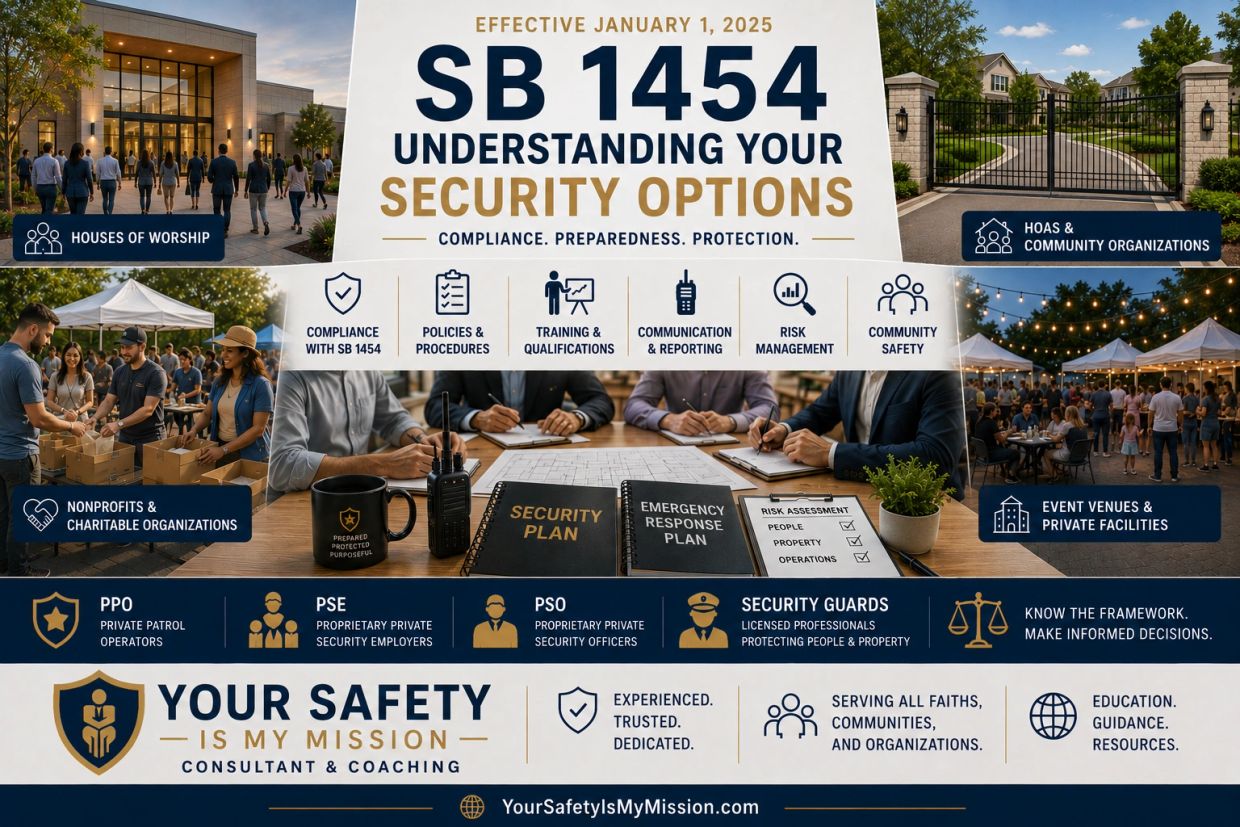
SB 1454 Understanding Your Security Options Effective January 1, 2025
SB 1454 Understanding Your Security Options Effective January 1, 2025
SB 1454 Understanding Your Security Options Effective January 1, 2025
SB 1454 Understanding Your Security Options Effective January 1, 2025
SB 1454 Understanding Your Security Options Effective January 1, 2025
SB 1454 Understanding Your Security Options Effective January 1, 2025
WHAT CHANGED UNDER SB 1454?
WHAT CHANGED UNDER SB 1454?
WHAT CHANGED UNDER SB 1454?
Effective January 1, 2025, California removed certain exemptions that previously applied to charitable and religious organizations under California's private security laws.
As a result, houses of worship, nonprofits, charities, HOAs, community organizations, and private facilities should evaluate how their security operations fit within
Effective January 1, 2025, California removed certain exemptions that previously applied to charitable and religious organizations under California's private security laws.
As a result, houses of worship, nonprofits, charities, HOAs, community organizations, and private facilities should evaluate how their security operations fit within California's existing security frameworks.
A common question we hear is:
"If the exemption was removed, what framework applies now?"
When reviewing California's security regulations, several established frameworks exist, including:
• Private Patrol Operators (PPO)
• Security Guards
• Proprietary Private Security Employers (PSE)
• Proprietary Private Security Officers (PSO)
Organizations should understand these frameworks and determine which option best fits their operational needs.
Security functions may include:
• Monitoring entrances and exits
• Access control
• Patrolling property
• Responding to disturbances
• Escorting disruptive individuals from property
• Protecting people or property
• Incident response and reporting
• Security monitoring during events or services
One important consideration is that the function being performed often matters more than the title being used.
Simply changing a team name to “Safety Team,” “Hospitality Team,” “Greeter Team,” or similar terminology does not automatically determine which regulatory framework may apply.
For official information, organizations should review current guidance available through BSIS.
AVAILABLE SECURITY PATHWAYS
WHAT CHANGED UNDER SB 1454?
WHAT CHANGED UNDER SB 1454?
California already provides several security pathways for organizations seeking to protect people and property.
Private Patrol Operator (PPO)
• Contract licensed security personnel
• Armed and unarmed options may be available
• Licensing, registration, and training are managed through the PPO
• Often the simplest option for organizations
California already provides several security pathways for organizations seeking to protect people and property.
Private Patrol Operator (PPO)
• Contract licensed security personnel
• Armed and unarmed options may be available
• Licensing, registration, and training are managed through the PPO
• Often the simplest option for organizations that do not wish to operate their own security program
Security Guard Registration
Security Guards generally must:
• Complete required training
• Complete Power to Arrest training
• Undergo Live Scan fingerprinting
• Pass DOJ and FBI background checks
• Obtain BSIS registration
• Complete continuing education requirements
Proprietary Private Security Employer (PSE)
• Operates an in-house security program
• Security personnel work exclusively for that organization
• Organization assumes responsibility for managing the program
Proprietary Private Security Officer (PSO)
• Works exclusively for one employer
• Cannot be contracted out
• Must complete required training
• Must complete fingerprinting and background checks
• Is an unarmed security position
Each organization should evaluate which pathway best fits its mission, risk profile, insurance requirements, and operational needs.
HOW WE CAN HELP
WHAT CHANGED UNDER SB 1454?
HOW WE CAN HELP
Our goal is not to create fear or confusion.
Our goal is to help organizations understand their options and make informed decisions based on publicly available information and existing California security frameworks.
We assist organizations with:
• Understanding SB 1454
• Security program evaluations
• Security framework reviews
• PPO refer
Our goal is not to create fear or confusion.
Our goal is to help organizations understand their options and make informed decisions based on publicly available information and existing California security frameworks.
We assist organizations with:
• Understanding SB 1454
• Security program evaluations
• Security framework reviews
• PPO referral options
• PSE and PSO education
• Security training pathways
• Risk management considerations
• Security team development
Many organizations are still asking the same questions:
• What changed?
• What framework applies to us?
• Can we maintain an in-house security team?
• What training may be required?
• What are our available options?
Every organization is different.
We encourage organizations to review current information through BSIS, consult legal counsel, consult their insurance providers, and determine what solution best fits their specific needs.
Need additional guidance?
Contact us to discuss your organization's goals, challenges, and available security options.
Frequently Asked Questions
Please reach us at support@yoursafetyismymission.com if you cannot find an answer to your question.
SB 1454 removed certain exemptions that previously applied to some charitable and religious organizations under California law.
As a result, many organizations are reviewing their security operations and evaluating how existing California security frameworks may apply to their programs.
Organizations that may wish to review their operations
include:
• Houses of worship
• Nonprofits
• Charitable organizations
• HOAs
• Community organizations
• Private facilities
• Organizations utilizing volunteer safety or security personnel
For official information, visit www.bsis.ca.gov.
In our opinion, this is one of the most important questions an organization can ask.
During our review of publicly available BSIS information, we identified several established security frameworks, including:
• Private Patrol Operators (PPO)
• Security Guards
• Proprietary Private Security Employers (PSE)
• Proprietary Private Security Officers (PSO)
Organizations should first evaluate what activities are being performed and then determine which framework may apply.
Understanding the framework is often more important than the title assigned to a team or individual.
This is one of the most common questions we receive.
During our review of publicly available BSIS materials, we identified established frameworks for Security Guards, PPOs, PSEs, and PSOs.
We did not identify a specific volunteer-security framework within the materials reviewed.
Based on that review, it is our opinion that organizations should carefully evaluate any volunteer security program and consult legal counsel, insurance professionals, and qualified security advisors before continuing or implementing such programs.
Organizations may reach different conclusions based on their specific circumstances, legal advice, and risk tolerance.
In our opinion, organizations should focus on the function being performed rather than solely the title assigned to a team or individual.
Activities such as:
• Access control
• Monitoring entrances and exits
• Patrolling property
• Protecting people or property
• Responding to disturbances
• Escorting disruptive individuals
• Security monitoring during events
• Incident response and reporting
may warrant further review regardless of whether a team is called Security, Safety, Hospitality, Ministry, Greeters, or another title.
Organizations should evaluate the activities being performed and determine what framework may apply.
During our review of publicly available BSIS information, we identified several established pathways:
Private Patrol Operator (PPO)
A licensed security company that provides security services to clients.
Security Guard
An individual registered through BSIS who completes required training, fingerprinting, background checks, and registration requirements.
Proprietary Private Security Employer (PSE)
An organization that operates its own in-house security program.
Proprietary Private Security Officer (PSO)
An unarmed security officer who works exclusively for a PSE and completes required registration, training, fingerprinting, and background check requirements.
Every organization should determine which option best fits its operational needs, risk profile, budget, insurance requirements, and long-term goals.
This is one of the most misunderstood areas of California security regulations.
A CCW (Concealed Carry Weapon) permit authorizes an individual to carry a concealed firearm under applicable California law.
However, during our review of publicly available BSIS information, we found that a Security Guard who carries a firearm while performing security functions must obtain a BSIS Exposed Firearm Permit in addition to meeting applicable security guard requirements.
In other words, a CCW permit alone does not automatically authorize an individual to perform armed security duties.
Organizations considering armed security should carefully review:
• Security Guard requirements
• BSIS Exposed Firearm Permit requirements
• Employment and contracting requirements
• Insurance requirements
• Applicable legal requirements
Organizations should consult legal counsel and review current BSIS requirements before relying on armed personnel for security operations.
If your organization is exploring security options, we may be able to connect you with trusted training and industry partners who can assist with:
• Security Guard training
• Exposed Firearm Permit training
• CCW training
• PSO education and requirements
• PPO security services
• Security program development
• Security-related training pathways
Every organization's needs are different, and understanding the available options is often the first step toward making an informed decision.
For official information, visit www.bsis.ca.gov.
While much of the public discussion surrounding SB 1454 has focused on houses of worship, our understanding is that other organizations may also wish to review their operations.
Examples may include:
• Homeowners Associations (HOAs)
• Nonprofits
• Charitable organizations
• Community organizations
• Private facilities
• Event venues
• Organizations utilizing volunteer safety or security personnel
Organizations should review current BSIS guidance, consult legal counsel, and determine whether existing California security frameworks apply to their operations.
Every organization is different.
A good starting point is to identify what activities individuals are actually performing and then evaluate what framework may apply.
Organizations should consider:
• Who is performing the activity?
• What duties are being performed?
• Is the activity focused on protecting people or property?
• Are individuals responding to disturbances?
• Are individuals monitoring facilities or events?
• What training, insurance, or liability considerations exist?
Organizations should review current BSIS guidance, consult legal counsel, and determine what solution best fits their operational needs.
In our opinion, organizations should focus on the function being performed rather than the title assigned to a team or individual.
During our review of publicly available BSIS information, we identified security-related activities that may warrant further evaluation, including:
• Access control
• Monitoring entrances and exits
• Patrolling property
• Protecting people or property
• Responding to disturbances
• Escorting disruptive individuals from property
• Security monitoring during events
• Incident response and reporting
Simply changing a team's name does not necessarily determine what framework may apply.
Organizations should evaluate the activities being performed and determine whether additional review is appropriate.
For official information, visit www.bsis.ca.gov.
Understanding the Framework Matters
The purpose of this information is not to create fear, confusion, or unnecessary barriers. It is to encourage organizations to understand the security framework they are operating under and make informed decisions based on their specific needs.
Whether you represent a house of worship, nonprofit organization, HOA, community organization, or private facility, protecting people is an important responsibility. Every organization is different, and the right solution may vary depending on your mission, budget, insurance requirements, risk profile, and operational goals.
Through our review of publicly available information, we identified several existing California security frameworks, including Security Guards, Private Patrol Operators (PPOs), Proprietary Private Security Employers (PSEs), and Proprietary Private Security Officers (PSOs). Understanding these frameworks is often the first step toward determining what options may be available to your organization.
From my experience working in security and serving houses of worship, I have seen firsthand the importance of preparation, training, situational awareness, and clear procedures. Security should support an organization's mission, not distract from it.
If your organization is evaluating security options, we may be able to assist with education, program development, PPO referrals, security training pathways, and understanding the available frameworks.
We serve organizations of all sizes and backgrounds with one goal in mind: helping people make informed decisions about safety, security, and preparedness.
Your Safety is My Mission
Copyright © 2026 Your Safety is My Mission - All Rights Reserved.
This website uses cookies.
We use cookies to analyze website traffic and optimize your website experience. By accepting our use of cookies, your data will be aggregated with all other user data.